.png)
Redtails and Payara in the Amazon
Clint and I fish together regularly, mostly in Kentucky but in other waters around the States as well. We are considered highly skilled fishermen in our area and capable in just about any water we have tried. So when Clint mentioned heading back to the Amazon and asked if I wanted to come along for another run, it felt like a natural extension of what we already do rather than a leap into the unknown. This was my second trip down there, but the Amazon still has a way of making you earn whatever you catch.
We made our way down to Manaus in the heart of the Amazon rainforest and from there we rode our small engine plane to a dirt airstrip. We had arrived back at the Amazon Roosevelt Lodge on the river that now carries Theodore Roosevelt’s name. His expedition passed through here in nineteen fourteen when it was still known as the River of Doubt. They were mapping country that had not been properly charted and dealing with the constant risk that things could go very wrong in a hurry. We had a lodge with actual beds and a boat that started when we needed it to, so we were already operating at a higher level of comfort than Roosevelt’s party ever managed. The river and the jungle around it still do not make anything easy.
The days settled into a pattern quickly. We would load the boat before the sun and run upriver for two hours or more, working into narrower sections where the forest pressed in on both banks. Our guide met us at the dock each morning. He spoke no English, and my Portuguese was still very much a work in progress after only a few months of study. We carried a phone with a translator that performed about as well as you would expect from a device trying to work two hours from the nearest reliable signal. Most of the time we managed with the words I actually knew, a fair amount of pointing, and the shared understanding that comes from both people wanting to catch fish. He turned out to be an excellent guide who knew the water and the fish in it. We got by well enough to keep things moving in the right direction.
The heat was the first thing that reminded us this was not a casual day on familiar water. It settled on you as soon as the sun cleared the trees and stayed there. We stayed covered from head to toe because the local insects treated exposed skin as an all-you-can-eat buffet. Even with all the precautions we took, the biting flies still managed to get through often enough to leave us with plenty of itchy souvenirs. Those bites itched badly for days afterward, and each one had a little spot right in the center where the fly had drawn blood. The bees were the size of birds, and the mosquitoes arrived right on schedule at dusk and dawn like they had been waiting for their shift. We might as well have been wearing hazmat suits in an effort to shield ourselves from the insects, but they were indefatigable.
While we traveled the river or stayed at the lodge the jungle was omnipresent. Monkeys howled with their haunting calls that carried far through the forest at dawn and dusk. Caiman larger than a man slipped into the water from the banks as we passed. Birds were constant. Scarlet macaws and blue-and-yellow macaws flew overhead in pairs. Flocks of parakeets filled the section of river called Paraqueita. Other parrots, shorebirds, vultures, egrets and herons appeared along the edges. Tree frogs infiltrated the bathroom in our cabin and called through the night. Large blue and green lizards basked in the clearings. Agoutis darted through the undergrowth. Butterflies appeared in large numbers across many different species. The trees stood out for their size. Kapok and jequitibá rose with wide buttress roots. Brazil nut trees and red angelim pushed high above the canopy. Palms lined sections of the banks and broke through the canopy. Massive philodendrons grew on branches. Epiphytes covered many limbs. Bromeliads climbed toward whatever light reached below. The biodiversity was staggering
Lunches were quick, eaten in the boat or on whatever sandbar happened to be nearby. Then it was straight back to casting. We did not waste time. We had come to fish, and we were after the ones that make you earn it.
We brought our own rods, reels, and lures because we wanted to fight the fish on gear we already trusted. The payara were usually the first to announce themselves. They hit hard, jumped repeatedly, and generally did their best to turn a simple cast into a complicated situation. Clint landed two trophies that stood out even among the fish we were seeing. He fought them with the steady approach that comes from experience, keeping pressure without giving them room to turn the fight into a disaster. They were exactly the kind of fish that make a long run upriver feel worthwhile.
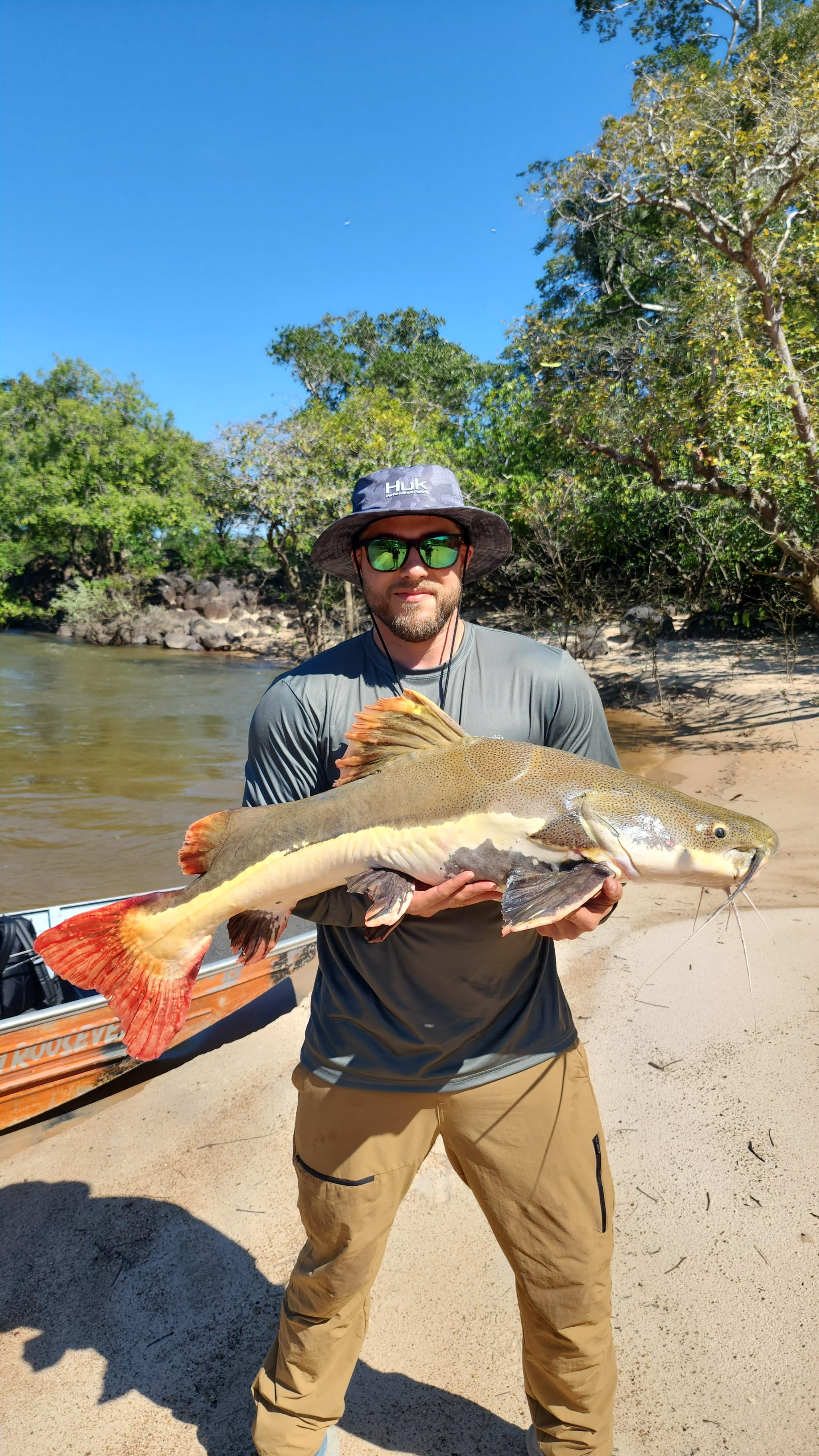
The redtail catfish were the ones that tested both the tackle and how much patience we actually had. Over the course of the week we brought 7 solid fish to the boat. Two of the larger ones measured 126 centimeters and 125 centimeters,(that's over 4 feet for you imperialists). They are heavy, determined fish that dive and head straight for the nearest cover the second they feel the hook. Even with the level of focus and fishing skill we bring to any water, those fish still made us work for every foot of line. The first big one I hooked made three long runs that each felt like they might be the one that finally sorted things out in the fish’s favor. I spent a lot of time gaining a few feet only to watch it take them right back. The second fish fought harder and longer, taking well over ten minutes before we finally hauled it in the boat. We took the required measurements and photographs, and let them go. These big fish are always released, along with most of the fish we catch. Pegue e solte.
We also caught peacock bass that hit like they had something personal to settle, several kinds of pacu that pulled deep and steady, various leporinus, jundia (leopard spoted catfish), apapa(some trophies of these guys, Clint even tied the Brazilian record!), matrinxa, knifefish, bicuda, and more piranhas than we bothered to keep track of. The variety kept the days interesting even when the bite slowed. Some of the fish we recognized right away. Others required a quick consultation with the guide using whatever combination of words and gestures we could put together at the time. The numbers were good, but it was the quality of the bigger fish and the fact that we were doing all of it on our own tackle that made the week feel like time well spent.
It is easy to forget, when you are dealing with a redtail catfish the size of a kayak, that somewhere back home someone is keeping a much smaller version in a tank and wondering why it keeps outgrowing the setup. The Amazon basin still supplies a large share of the fish that move through the ornamental trade. Peacock bass, known locally as tucunaré, are popular in the cichlid hobby because they are colorful, active, and willing to feed in captivity. The same species that grow into the powerful fish we were hooking start out as juveniles that end up in home aquariums. Redtail catfish appear in the trade as smaller specimens and eventually require the kind of space most people cannot provide, which is why you tend to see them in larger public displays or with keepers who plan around serious size. Pacu and certain piranha species also move through the trade. Even many of the smaller characins and catfishes that share these waters contribute to the steady supply that stocks community tanks everywhere. Seeing them here, in the water where they actually live, makes the connection between the wild river and the glass box back home feel much more immediate.
By the end of the week we were tired, bug bitten, and thoroughly satisfied with what we had managed to catch. The variety was solid, the quantity was better than we had counted on some days, and the quality of the bigger fish was exactly what we had hoped for when we planned the trip. Clint and I have done enough of this sort of thing to know that you do not always get the fish you want, but this time the river cooperated. We came home with new stories, a few new aches, and a clearer sense of why the work we do at Prestige Aquatics matters. The fish in our breeding systems and the ones we help customers keep all started somewhere.
Until next time,
Nolan
Nice work. Keep it. I enjoyed the read.